
What Words Cannot Explain: Painting the Human Experience
Daniel Tagbo’s paintings operate somewhere between instinct and structure, where faces become psychological landscapes, animals absorb the tensions of human behavior, and symbols shift between memory, violence, escape, and freedom. Working across acrylic, oil stick, pastel, and ink, Tagbo builds images through a process of accumulation and revision, allowing spontaneous marks to coexist with deliberate reflection. What emerges is less a fixed narrative than a mutable mirror: one in which personal memory and subconscious imagery open outward, inviting viewers to encounter their own associations within his deconstructions of human experience.
From ArtVanguard Editorial Team
Artist Biography
Daniel Tagbo is a painter based in Queens, New York. Drawing on human expressionism and symbolism, his drawings and paintings investigate society, taking the form of spontaneous deconstructions of reality. With a degree in fashion and a minor in fine arts from St. John’s University, Daniel takes a mixed-media approach, usually combining acrylic with oil stick or pastel. He has shown his work in several group shows throughout New York and recently completed a residency at Liquitex’s Industry City studio.
Artist Website: https://danieltagbo.com
Instagram: @danieltagbo
Artist Statement
Art is deeply personal to me and immediate. My work feels like a journal of unconscious understanding, a mirror anyone can hold up and see a piece of themselves in, through these complex deconstructions of humanity.
Interview with Daniel Tagbo
Q1. You earned a degree in Fashion with a minor in Fine Arts from St. John’s University. How does fashion’s language of structure, tailoring, spatial relations around the body, and the tactility of fabric inform your current painting practice?
Fashion really informed my approach to conceptual storytelling within art. The way my work deconstructs the world through the human body draws on Martin Margiela’s sense of deconstruction. A lot of my feelings toward surrealism and storytelling developed through studying McQueen, and I’m a big Virgil fan as well. Just like fashion, my art is fully shaped around the human body and experience. Working closely with fabric helped me develop an intuitive sense of texture, especially as a way to add depth to my work. Fabric is like a second skin, and I like to compare it to the way paper or canvas can be a “skin” for the subjects I depict.
Q2. Some of your works feel close to scenes from dreams, theater, mythology, or social satire. Are there particular visual sources—films, comics, fashion, music, street life, personal memories, or other images—that feed your imagination?
Growing up, comics and cartoons were a big inspiration for me and helped me learn how to draw. Now, a lot of my inspiration comes from music. I think it’s beautiful when an artist can write a line or a melody that speaks to different situations and perspectives. Then it becomes a song you can carry with you throughout your life. I try to do the same with art, creating images that have multiple meanings and can capture the complexity of life. Movies are a beautiful source of inspiration as well. I’m always looking for images that I feel moved by.
_JPG.jpg)
Daniel Tagbo, Say Goodbye to Love, 2026. Acrylic and oil pastel on canvas, 22 × 38 in.
Q3. Your mixed-media practice frequently layers acrylic, oil stick, and pastel. How do these materials affect the speed, pressure, and emotional intensity of your mark-making?
I like those materials for their speed. The textures I try to create through mixed media act as another point of communication, adding their own layer of rhythm and contrast. Acrylic allows me to think through my color palette in a very intentional way. This balances out the speed of the drawn elements in a lot of my work. During this process of switching between painting and drawing, I begin to build a map of my thoughts and feelings within the piece, deconstructing ideas by adding and removing elements.

Daniel Tagbo, Promised Land, 2026. Acrylic and oil stick on canvas, 44 × 38 in.
Q4. Many of your works feel as though they emerge from a meeting point between the conscious and the unconscious. How do you balance accident, instinct, and structure while working?
It’s definitely a process of communicating between worlds. Instinct and structure both have their roles in a painting. I usually want the work to start in an intuitive place, born from the feelings and thoughts that are pressing most heavily on my subconscious. Once the idea is clear, I like to take long pauses while working, allowing myself time to think through the execution. Together, these spontaneous and thoughtful ways of working build a rhythmic structure in my work, and often it’s a very revealing and self-reflective process.
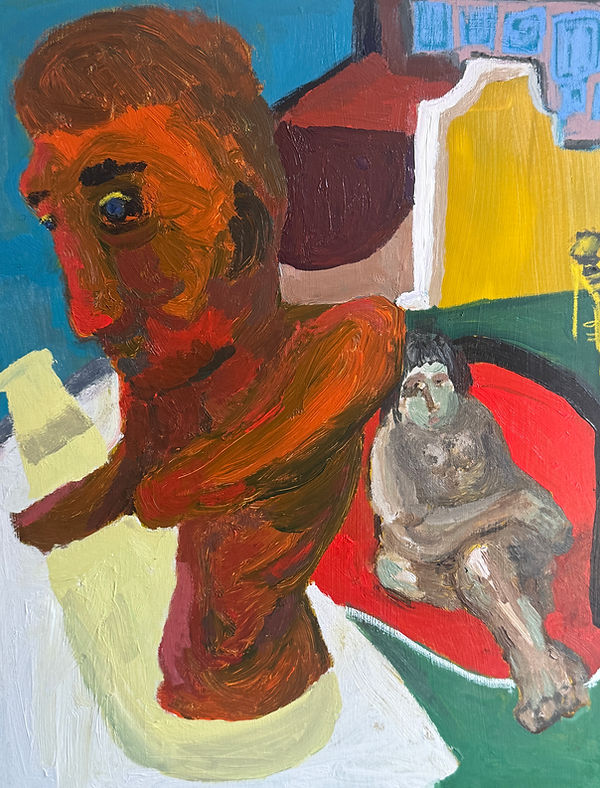
Q5. In works like Man, RatKing, and Something’s Missing, the face becomes almost a psychological landscape, with features that feel exaggerated, vulnerable, and unresolved. How do you approach facial expression in your paintings, and what do you want the gaze of these figures to hold?
Faces are the main area of communication. Faces help me capture the complexity of emotions that escape definition. At the same time, faces are a mirror. The way we interpret faces and how they make us feel is simply a reflection of our biases and past experiences with emotion. In my art, I lean into that complexity, and I treat each face as a story, with impressions and details that tell you about the figure’s history. To me, the faces usually hold a mixture of emotions, often with an underlying sadness. I like when a subject’s eyes have a weight to them; it gives a sense of understanding, like a mind that has witnessed much of the reality of life.

Daniel Tagbo, RatKing, 2026. Acrylic and oil pastel on canvas, 30 × 40 in.

Daniel Tagbo, Man, 2026. Acrylic on canvas, 18 × 24 in.
_JPG.jpg)
Daniel Tagbo, Something’s Missing, 2026. Acrylic and oil stick on canvas, 40 × 30 in.
Q6. Symbolism plays an important role in your paintings, but the images rarely feel fixed or fully explained. How do symbols enter your work, and do they carry stable meanings for you, or do they change from painting to painting?
Symbols are really important to me. I think they enter my work as a way for the subconscious to communicate—an image within an image. Symbols ground the paintings in these smaller ideas that are quickly recognizable. But their true meaning depends on the context. A plane can suggest a fighter pilot or become a symbol of escape. Kamikaze or freedom. Context is everything. Symbols can often be about memory too, and can work as a reminder to think about a certain memory or feeling. With symbols, I can both determine how I feel and create an understanding for myself of where a viewer’s mind might go when looking at the painting.
Q7. Across works such as Bull Fighter, Animal Farm, and Jailbreak, animal figures appear repeatedly as presences, symbols, or extensions of human behavior. What first drew you to animal imagery, and how do these figures help you explore human emotion, instinct, or social behavior?
Growing up in Missouri, I was surrounded by nature. There were times in my childhood when we lived in especially rural areas, and I hold fondly to memories of neighbors with horses or pigs, and friends who would collect snakes and lizards. From a young age, I tried to keep as many pets as my family would let me. I fell in love with drawing through animal imagery. When I was around seven years old, I began getting books on drawing animals and plants. Nature is an important thing to consider when portraying human behavior. Nature—especially animals—may be among the only witnesses to human existence; their perspective is important. In pieces like Animal Farm, I’m channeling the psyche of the cow, reacting to animal sacrifice and agriculture. In Jailbreak, a pig takes on a more symbolic meaning, representing the social connotation of the pig as a police officer. Using the pig in a way that is distanced from its nature highlights the socially constructed quality of the prison institution, a concept that is itself distanced from the vast freedom of the natural land on which prisons are built.

Daniel Tagbo, Animal Farm, 2026. Acrylic and oil stick on canvas, 30 × 40 in.

Daniel Tagbo, Jailbreak, 2026. Acrylic and oil stick on canvas, 24 × 24 in.
Q8. In Bull Fighter, the animal presence feels especially charged, almost as if the bull carries an emotion, conflict, or force outside the human figure. How do you think about the relationship between the human body and the animal body in this work?
Humans share anatomical structures with a lot of animals. In Bull Fighter, I’m using that shape as an analogy through which I can compare the psyches of the man and the bull. The man reaches for a weapon in blind anger, and in that moment, his mind is the same as that of the bull charging at a matador.

Daniel Tagbo, Bull Fighter, 2026. Acrylic and ink on paper, 18 × 24 in.
Q9. Can you talk about your recent involvement with Liquitex’s “Just Imagine” residency? How did that experience affect your studio practice or open up new possibilities in your work?
Having the space to create much larger works was freeing. Seeing my paintings from a distance and side by side with my other work was crucial for building a collection. My favorite part of having that studio was being able to host studio visits. Having conversations about creativity and life, and being able to show people my work in a private setting, made it a really special opportunity.
Q10. When you are not painting, what kinds of places, sounds, people, or everyday moments make you feel most creatively awake?
I find inspiration anywhere, but it always comes in moments. A night out, a line in a song, an introduction, even a moment of realization—all feel like stories to bring to my canvas. I find a lot of inspiration in music specifically, both in listening to it and making it. A lot of my friends are musicians, and when I join them in the studio, I’m always intrigued by the similarities between making music and painting.
Q11. You have described your work as a mirror that “anyone can hold up and see a piece of themselves” within complex deconstructions of humanity. Looking ahead, what kinds of subjects, formats, or scales do you hope to explore next in order to deepen that mirror?
I’ve been thinking a lot about mental health and its connection to creativity. A lot of our favorite artists have struggled with addiction and mental health problems. Pain holds an interesting place in art as well; it’s a very potent emotion. I’m interested in exploring the relationships between these ideas through highly physical paintings. I’m constantly working on new concepts in search of new ways to describe the world we live in through art.
.jpg)
Daniel Tagbo, Dead End, 2026. Acrylic and oil stick on canvas, 72 × 60 in.