
Art in Transition: Kyoka Katori on the Confluence of Ukiyo-e, Dolls, and Baroque
Kyoka Katori's work stands out in the contemporary art landscape for its seamless integration of traditional Japanese ukiyo-e and French Baroque influences, creating a striking visual narrative that explores modern identity and cultural hybridity. Her meticulous attention to detail and the emotional depth of her compositions reflect a profound connection to her cultural heritage while also engaging with broader, more universal themes of vulnerability and strength. Through the lens of art history, Katori's style can be seen as a dialogue between the past and the present, where classical techniques are reinterpreted to address contemporary issues.
Her works are infused with an introspective quality that challenges viewers to contemplate complex issues of identity, transformation, and the human condition. Her ability to weave intricate stories through her chosen mediums contributes to a richer understanding of the multifaceted nature of contemporary art. As an artist, Katori continues to push the boundaries of traditional aesthetics, ensuring her place within the evolving narrative of art history.

Q1. Your work has been influenced by Japanese ukiyo-e, dolls, and French Baroque culture. Can you elaborate on how these influences manifest in your art, and how they shape your artistic style and thematic choices?
My art draws heavily from the precision and emotional depth of Japanese ukiyo-e, the fragility symbolized by dolls, and the grandeur of French Baroque. Ukiyo-e’s emphasis on detailed lines and capturing fleeting moments inspires my compositions, while dolls evoke vulnerability and identity, themes I often explore in my work. The opulence and drama of Baroque culture have influenced my love for creating emotionally charged, intricate works that explore the transient nature of beauty and human relationships.
Q2. How has your time studying at the New York Academy of Art influenced your work? Are there specific techniques or perspectives you have adopted during your studies that are evident in your recent pieces?
Studying at the New York Academy of Art has profoundly expanded my technical abilities and deepened my conceptual approach. I’ve refined my understanding of anatomy and form, which has greatly enhanced the way I depict the human body in my paintings. The emphasis on classical techniques, combined with contemporary perspectives, has allowed me to blend tradition with innovation in my recent works. I have also gained a more structured way of integrating existentialist themes into my art, making them more accessible to the viewer while still maintaining the emotional depth and complexity I aim for.

© Kyoka Katori, Katori’s Blind Dolls, digital painting, 2024
Q3. “Cocoon” (2024) captures the balance between traditional femininity and modern trials. Can you discuss the symbolism of the tattoos and the narrative you intended to portray through this piece?
In “Cocoon,” the cocoon wrapped around the figure represents transformation—a metaphor for the process of shedding old identities and emerging as a new self. The tattoos, on the other hand, symbolize rebellion, an outward expression of defiance against societal norms and expectations. This juxtaposition between the cocoon and the tattoos reflects the tension between the internal growth and external pressures that women face in both traditional and modern contexts. Through this piece, I aim to convey the complexity of evolving one’s identity while resisting the constraints imposed by society.
Q4. You mention that your work is influenced by various forms of art and culture, including music and literature. Can you discuss a specific piece where you integrated these interdisciplinary elements?
One of my works where interdisciplinary influences are most evident is "Deep River" (2024). This piece was deeply inspired by Hikaru Utada’s album Deep River. The emotional depth and introspective nature of the album shaped the overall mood and tone of the painting. The fluidity of the music and its exploration of inner struggles influenced my choice of soft, flowing lines, evoking a sense of movement and emotional complexity.

© Kyoka Katori, Cocoon, digital painting, 2024


© Kyoka Katori, Deep River, digital painting, 2024
Q5. . Your painting “Yuri” (2024) explores the duality of life and death through the symbolism of the lily. How do you approach integrating such complex themes into your work, and what message do you hope to convey to your audience?
In “Yuri” (2024), the lily serves as a powerful symbol of both purity and death, reflecting the delicate balance between life and mortality. I often use flowers, especially lilies, to represent the transient nature of beauty and existence. The duality of the lily in this painting reflects the inevitable cycle of life and death, with its pristine white petals symbolizing purity while its association with funerals evokes thoughts of impermanence. Through this work, I aim to remind the audience of the fleeting nature of life, encouraging them to embrace both beauty and decay as intertwined aspects of the human experience.
Q6. You have exhibited your work internationally in places like New York, Paris, Tokyo, and Finland. How do the different cultural contexts and audiences influence the way your work is received, and do you adapt your presentation or themes to suit each location?
Exhibiting internationally has given me a unique perspective on how cultural contexts influence the reception of my work. In New York, audiences tend to focus on the technical aspects and the emotional depth of my pieces, engaging with the existential themes I explore. In Paris, there is often a greater appreciation for the historical and aesthetic influences in my work, especially the Baroque and Rococo elements. In Tokyo, my exploration of Japanese traditions, such as ukiyo-e and the symbolism of dolls, resonates more deeply with the audience’s cultural background. In Finland, the minimalist yet emotive approach in my work was met with interest in how it bridges different artistic traditions. While I don’t change my core themes, I do adjust how I present the context and narrative to make it more accessible to each audience, ensuring that the cultural nuances are appreciated.

© Kyoka Katori
Q7. “Deep River” (2024) is rich with metaphors about the flow of life and human emotions. What philosophical reflections and personal experiences drive the creation of this piece, and how do you translate these abstract concepts into visual art?
“Deep River” (2024) reflects my philosophical exploration of life’s continuous flow, much like a river that never stops moving yet changes constantly. Inspired by both existential philosophy and personal emotional experiences, the piece explores the impermanence of human emotions and the cyclical nature of life. I drew from my own moments of loss and renewal, where emotions felt overwhelming but eventually evolved into something new. The fluidity of the brushstrokes and the interplay of light and shadow represent the ebb and flow of these feelings. By using these visual metaphors, I aim to evoke a sense of both tranquility and turbulence, symbolizing the complex journey of human existence.
Q8. In “Frame” (2024), you explore how invisible social frames shape individual self-perception. How do you use visual elements to depict these psychological and cultural restraints, and what personal experiences influence this portrayal?
In “Frame” (2024), I use visual elements such as a rigid, almost suffocating headpiece that resembles a frame to represent societal constraints. The figure’s expression is one of confusion and entrapment, highlighting how invisible social expectations can shape and limit individual identity. The juxtaposition of a delicate figure within a harsh frame creates a visual metaphor for the pressure many feel to conform to societal norms. This piece is inspired by my own experiences of feeling confined by cultural and gendered expectations, where individuality is often suppressed in favor of fitting into predefined roles. Through this work, I seek to provoke questions about how much of our identity is truly our own and how much is shaped by external forces.
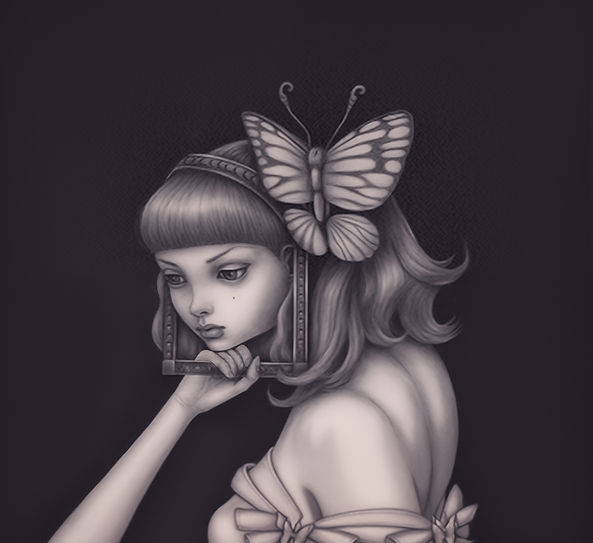
© Kyoka Katori, Frame, digital painting, 2024
Q9. What has been the most challenging piece you have worked on so far, and how did you overcome the obstacles you faced during its creation?
The most challenging piece I’ve worked on so far is “Cocoon” (2024). The complexity lay in its emotional intensity and the personal connection I had to the themes of transformation and rebellion. As I worked on this piece, I encountered moments of self-doubt and hesitation, especially in conveying the depth of the internal struggle I wanted to express. There were times when I felt overwhelmed by the themes of vulnerability and strength as they mirrored my own personal growth. To overcome these obstacles, I took breaks and allowed myself time to reflect, often returning to the piece with a clearer vision. Meditation and journaling helped me reconnect with the emotional core of the artwork. Ultimately, “Cocoon” became not just a finished painting but a process of catharsis and self-realization.
Q10. Looking ahead, what are some themes or concepts you are interested in exploring in your future works? Are there any new techniques or mediums you plan to experiment with, and what goals do you have for your artistic career in the coming years?
In the future, I’m interested in delving deeper into the themes of identity transformation and existentialism. I want to explore how these ideas intersect with modern issues like technology, isolation, and mental health. As for techniques, I plan to experiment more with mixed media, incorporating elements like digital art and sculpture to add more dimensionality to my work. I’m also interested in integrating more interactive components into my pieces, allowing viewers to engage with the artwork on a deeper level. Over the coming years, my goal is to push the boundaries of my art not only by refining my skills but by creating works that challenge societal norms and spark meaningful conversations. I aspire to continue exhibiting internationally and hope to reach a broader audience while staying true to my personal artistic journey.