
The Stories That Keep Us Awake: On Memory, Community, and Civic Life
Myra Eastman’s narrative paintings bring personal memory, civic life, and political history into densely layered visual worlds. Rooted in Santa Cruz, where she has lived since 1973, her practice moves from migration, voting, education, and war to illness, recovery, and generational change. Through fragmented, collage-like compositions, Eastman treats storytelling as both a formal strategy and an ethical act, giving individual lives weight within larger historical forces. Her work reflects a sustained belief in art’s capacity to build empathy, preserve memory, and make public events feel intimate. Across decades of painting, community remains both her subject and her grounding: a space of conflict, care, responsibility, and renewal.
From ArtVanguard Editorial Team

Portrait of Myra Eastman
Artist Biography
Myra Eastman was born in Los Angeles, California, and lives in Santa Cruz, California. She is a 2019 recipient of the Santa Cruz County Rydell Fellowship, which supports individual visual artists in pursuing their creative work and is awarded solely on the merits of their artistry, without being tied to the completion of any specific project. In addition, her work has been featured at the Santa Cruz Museum of Art & History, Museo Eduardo Carrillo, and Monterey Peninsula College. She was invited to the Santo Foundation’s 2019 10th Anniversary Invitational Exhibition, held at Webster University in St. Louis, Missouri. Her work has appeared in the Catamaran Literary Reader, American Art Collector, and Studio Visit. Her paintings have been purchased by the Contra Costa Medical Center as part of its “Resilience Project” permanent collection. In 2025, Revolution Medicines, a biotech company in Redwood City, commissioned Myra to create a large-scale painting celebrating the diversity of the company. Her latest work, Santa Cruz: Then & Now, has just been installed at the Santa Cruz Museum of Art & History.
Website: www.myraeastman.com
Email: myra@myraeastman.com
Artist Statement
My artwork spans over 35 years. My work is grounded in both political and social narratives. Stories are a major theme in all this work. Whether deeply personal (Family Portraits, Mulholland Dr., Pancreatic Cancer) or political and social in nature (Great Northern Migration, Voting Series, Covid Diaries, Don’t Take My Dad), stories humanize our common humanity and dignity. Stories also help me understand my past and help make sense of the chaos surrounding the present.
Most of my paintings give viewers more than a single story; they offer multiple narratives and vignettes. The paintings are both quilt-like and collage-like, with stories within and behind others. Sometimes the path forward is a bit crooked, as I have all the pieces and strive to bring it all together as a whole.
I believe artists have a unique role in affecting social change as art touches the soul and challenges how we see ourselves. I am deeply grateful to have this creative ability to express that which keeps me up at night.
Interview with Myra Eastman
Q1. You were born in Los Angeles and have lived in Santa Cruz for more than five decades. How has Santa Cruz shaped not only the subjects you paint, but also your understanding of community, political responsibility, and what it means to be a local artist?
I have lived in Santa Cruz since 1973, moving here when I was 19. For five decades I’ve been a part of this community, as a student, school teacher, parent, activist and artist. I’ve learned that Santa Cruz is beloved and not that different from communities everywhere. It’s beautiful, creative, quirky and far from perfect. It’s been a gift to have been connected to a community for so long and to have experienced all the transformations. And it has taught me that community isn’t something you take for granted. It must be nurtured and treasured. I’ve experienced the natural disasters that brought out the best in us. The 1989 Loma Prieta earthquake shattered our community, but we stood together and rebuilt. When the CZU wildfire in 2020 caused one-third of our population to evacuate, there was an outpouring of support.
I’ve learned that as each generation makes its mark, conflict and resentment follow in its wake. People here feel threatened by change. Many here fear that what they have so passionately built will be lost as our downtown and neighborhoods are transformed to create desperately needed new housing, forgetting that we too changed everything when we arrived here. This is the defining conflict in Santa Cruz in 2026, and it’s tearing the community apart.
I’ve come to understand that political responsibility takes many forms and no one has all the answers. Being the loudest isn’t for everyone. Being kind to your neighbor is as important as marching in the streets. And I have come to understand that it’s way past time for my boomer generation to step aside and encourage younger voices to rise up. For me, as a narrative painter, I have reveled in these stories of change, conflict and responsibility. Being a local artist here is simply who I am.
Q2. Your practice has developed over more than thirty-five years and moves between deeply personal experiences and broader political and social histories. When did you first recognize storytelling as the central language of your work, and how has your narrative voice changed over time?
I was born in 1954, a lonely, shy, youngest-of-three kid growing up in a troubled Jewish family in the Los Angeles suburbs. Books saved me. I could shut out the misery by burrowing into stories that imagined different worlds and a kinder family. It’s no accident that stories are central to my work. It’s how I understand the world. And it’s the hook I employ to draw the viewer in.
I don’t think my narrative voice has basically changed over time. I still strive to bring my figures to life, to make them matter. I’ve always imagined my figures less as realistic renderings and more as archetypes that I imbue with stories worth telling. I peek into their souls and hope to convey their humanity. But as I’ve become more confident and experienced, I can now usually see in my mind’s eye how bits of the composition on the canvas will work before I lay down paint. I can now create complicated vignettes with multiple viewpoints and distort perspective to attain desired outcomes.
Narrative storytelling has allowed me to respond to political and social imperatives and make sense of the world. I have some guilt when I’m not solely focused on political/social work, that it’s too indolent to focus solely on personal travails when the world is burning and my attention is elsewhere. As I age, this has become an even greater imperative. I believe artists have a critical part to play in creating empathy and connection, and I fear my time is limited.
Q3. Your subjects range from migration, voting, and public health to family history and personal illness. What does your research process look like, and what roles do news images, historical sources, direct observation, memory, and imagination play in developing a painting?
I am reluctant to give a definitive answer as to how I develop a painting. I worry that it may become too formulaic if I am always doing the same thing, and I never want to repeat myself. That being said, I have figured out a few things in the last few years that are consistent and seem to be working.
I work in a series. I imagine my paintings as part of a whole, short stories within a larger context. It gives me the space to explore in depth what I want to say. This hopefully makes me a bit less neurotic, worrying that I need to get everything in on the first try and overwhelm the painting. So before I begin a new series, I force myself to pause and reflect. I realize I’m going to live with these images for a while and want to make sure there’s a reason to pursue this narrative and enough to say. Once the subject matter has been decided, I begin my search for everything I can get my hands on. The Family Portraits series came by way of lost and then found b/w slides taken by my uncle in the 1940s. When I needed Santa Cruz landscapes in which to place my fleeing Syrian refugees (Forgotten & Forsaken series), I schlepped my box easel outside. Before the Internet, libraries, used bookstores and magazines were my primary sources of inspiration. Now Google offers a trove of images that I gratefully repurpose.
Q4. Alongside your studio practice, you spent many years working as a public school art teacher. How did teaching influence the way you communicate complex ideas visually, and did working with young people change how you think about audience, empathy, or accessibility?
I didn’t start out as an art teacher. I began my teaching career in 1976 as a bilingual (Spanish/English) primary school teacher working with migrant students in Watsonville, California. I didn’t take my first college art class until 1985, which changed my life. Teaching became my day job as creating art took prominence. In 1994 I finally had the confidence, experience and art credits to be hired to develop and teach a visual arts program at a local elementary school.
My art classes were grounded in foundational art principles, quality materials and a calm, organized classroom. Step-by-step complex skills were scaffolded, allowing all students, regardless of prior experience or skill level, to engage and succeed with the curriculum. Process was emphasized, experimentation key. Kids are a tough audience. They say what’s on their minds without the adult filter. And they really let you know when you aren’t succeeding. They made me work harder, determined to get it right. They taught me less is more. Be real, be yourself, be open and kind. And I had the best job in the world.

Myra Eastman, Covid Diaries #1: Gone People Gone, 2021. Acrylic on canvas, 46 × 38 in.

Myra Eastman, Covid Diaries #2: Miss You!, 2021. Acrylic on canvas, 46 × 38 in.
Q5. You describe your compositions as both quilt-like and collage-like. What draws you to building a painting from fragments?
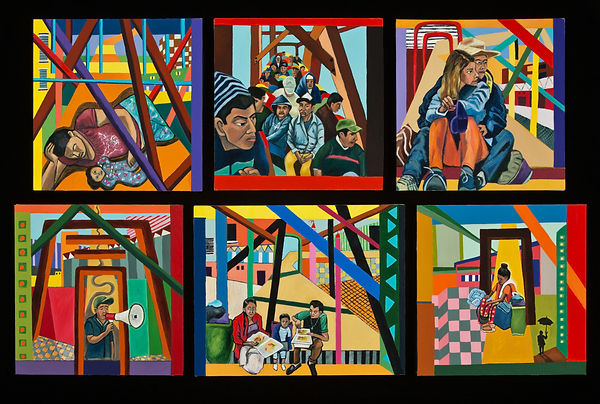
I began creating paintings with multiple narratives and vignettes several years ago. This started when I had more to say than would fit on the canvas. I was running out of room and everything started to squish together. I worried the picture plane was getting too crowded, too overworked. I love working big, which helped, but not enough. So little by little my paintings moved into more surrealistic imagery, where perspective was relative and stories overlapped. I then had to figure out how to keep everything together as a cohesive painting, rather than a bunch of pieces. This is where color, pattern and movement helped, tying the fragments together. In order to avoid regurgitated tropes and clichés, I used metaphors. And I started using images iconically, such as coyotes, hidden cameras and secret doors. I slowly figured out how to create stories within and behind others.
Q6. Works like Voting Series: Standing in Line and Man with Magnify Glass (2009) capture the deliberate, solemn weight of casting a paper ballot. Reflecting back on these works in 2026, how do you view the evolving fragility and resilience of democratic participation?
My series, November 4, 2008 Voting Series, was conceived as a celebration of democratic renewal. It was at a time when many on the Left felt disillusioned by our political system. Why bother voting when all political parties are corrupt? The 2008 presidential election was a collective awakening and showed that change was possible. Your vote really mattered! Polling places became symbols of renewal, of possibilities, of hope.
In 2026 that heady time seems like ancient history. Who knew progress was so fragile and could so easily be rolled back? Who knew authoritarianism was so close to the surface that we now fear free and fair elections are a thing of the past? It’s a shocking time, with despair lingering. But with our institutions falling apart or being dismantled comes an opportunity again for renewal. So many of our problems have been left to fester: inequality, systemic racism, etc. We’ve looked away for too long, ignoring the most fragile, vulnerable among us. We must get involved not just to protect what we’ve already lost, but to create a better future. Once again, voting has become not just “choosing the lesser of two evils” but a sign of collective awakening. There are seeds of democratic resilience popping up everywhere. Giving up isn’t an option. I still have hope.

Myra Eastman, Voting Series: Standing in Line, 2009. Gouache on wood, 22 × 32 in.

Myra Eastman, Voting Series: Man with Magnify Glass, 2009. Gouache on wood, 21 × 18 in.
Q7. Trains, buses, airplanes, waiting lines, checkpoints, borders, and systems of transportation recur in works such as Migration North: Traveling by Rail, Occupation Series: Doves, and Don’t Take My Dad. What does movement, or the restriction of movement, allow you to explore about freedom, belonging, and power?
Freedom of movement is a fundamental human right. I am the daughter of first-generation Russian Jewish immigrants. All my grandparents made that voyage across the sea. Migration is the story of our survival. And growing up, those WWII Nazi movies didn’t feel so distant. I was haunted by the thought that a knock on the door could mean the end. As I grew older, I began to understand that freedom of movement is the luck of the draw. Being born in a country where you are accepted and feel you belong is a privilege. I have been drawn to the stories of people who have not been so lucky. I can’t look away from the torment of refugees and migrants fleeing war, violence, economic collapse or global warming. I have to paint their stories and amplify their voices. With the unimaginable sight of armed, masked federal agents terrorizing our immigrant neighbors and an ICE concentration camp planned just south of Santa Cruz, I had to paint Don’t Take My Dad.


Myra Eastman, Occupation Series: Doves, 2004. Oil paint stick on paper, 98 × 204 in.
Myra Eastman, Don’t Take My Dad, 2025. Acrylic on canvas, triptych, 9 × 4 ft.
Myra Eastman, Migration North: Traveling By Rail, 2019. Acrylic on canvas, six panels: five at 16 × 16 in. and one at 20 × 16 in.
Q8. In God & Country: Morning Lessons, the classroom becomes a site where religion, patriotism, authority, media, and childhood intersect. What led you to bring these forces together within an educational setting, and what questions did you want the painting to raise about how national identity is taught and rehearsed?
The painting God & Country: Morning Lessons charts the intrusion of White Christian nationalism into mainstream American life. I was incensed by the vilification of public school teachers in the current political climate. Really! It’s beyond shocking that right-wing groups are spreading lies that teachers are somehow in cahoots with wokeism, plotting to infiltrate young minds with left-wing ideology. With the rise of parents’ groups like Moms for Liberty, book banning is real and school curriculums are challenged for celebrating diversity and inclusion. It’s nuts. And it’s dangerous for all of us who value our First Amendment rights. In this painting, state power (as depicted by the police officer) is linked with the looming cross to inculcate White Christian nationalist ideology in the next generation. The painting also highlights the White Christian nationalist nostalgia for early American pioneer days. This seems to be a coded reference to a mythical time in American history where everyone was white, pure, God-fearing and patriotic. The students in this class are being indoctrinated into authoritarianism with a dose of God and Country.

Myra Eastman, God & Country: Morning Lessons, 2025. Acrylic on canvas, 38 × 46 in.
Q9. Your Pancreatic Cancer series grew out of your own diagnosis, treatment, and recovery. You have described painting as a way of confronting an experience that continued to affect you even as your body began to heal. How did making this series change your understanding of illness, vulnerability, and recovery—and what did it mean to paint an experience from within?
When I was diagnosed with advanced pancreatic cancer in 2023, I was told it was incurable. But after 12 chemo cycles, the tumor shrank and I had successful surgery nine months later. I was called the “miracle survivor.” I was ecstatic that I had, so far, survived and, after recovering from surgery, was determined to reclaim my pre-cancer life fast. I didn’t want cancer to take up any more space in my mind. I had been working on a project before I got sick, and once I was able to get back into the studio I plowed ahead, hoping to finish what I had started nine months earlier. But as my body slowly healed, I knew something was wrong. I was haunted by what had happened to me. I was finally diagnosed with PTSD and, as a narrative painter, was advised to paint this experience as a way to heal. I did not want to and ignored this advice until I couldn’t. Anything that reminded me of being sick still caused anxiety, and the flashbacks were continuing. So I began this series of paintings. These are paintings that painted themselves. They made me confront the terror, the pain, the boredom of being sick. And it worked. As the paintings stacked up in my studio, I got better.

Myra Eastman, Pancreatic Cancer #2: CT Scans, 2024. Acrylic on canvas, 46 × 38 in.
I started this series, Pancreatic Cancer, as a way to heal myself. But as the series continued, I realized I also wanted to express how it really feels to be a cancer patient. Sliding into the CT scan, terrified of the results. Hanging out in the infusion clinic for six hours at a time, knowing the chemo pumping through my port would soon leave me frail and back to bed. I have been told these paintings are difficult to look at. I have heard that they show too much sorrow and despair. Honestly, I was surprised. I don’t hear this from those of us living with cancer. We know how this all feels. We know it’s important to show this often-hidden side of cancer: the fear, the hope, the pain, the loss, the everything when your world is forever changed.
Surprisingly, all the paintings in this series were bought by the biotech company Revolution Medicines for its campus in Redwood City. (This company has just had its new, remarkable pancreatic cancer drug approved by the FDA and is changing the course of this disease.) The founders of this company wanted these paintings hanging in the halls of their campus to put a human face on the true lived experience of pancreatic cancer patients. I have been told these paintings have helped the employees feel a direct connection to the work they do.

Myra Eastman, Pancreatic Cancer #1: Inside the Infusion Clinic, 2024. Acrylic on canvas, 46 × 38 in.

Myra Eastman, Pancreatic Cancer #7: Our Caregivers, 2024. Acrylic on canvas, 46 × 38 in.
Q10. You write that art allows you to express "that which keeps me up at night". Over a 35-year career spanning major global events, from the Occupation series (2004) to your latest 2026 triptychs, how have those late-night concerns evolved, and what has remained constant?
It’s hard to believe I’m the age I am. My generation didn’t trust anyone over 35, and here I am 72 years old. I think as I’ve aged I’ve mellowed (a bit). I’ve learned that finding joy doesn’t mean I’m any less committed to progressive change. It’s okay to be happy. And I now understand that building community paves the way, that to get through this we need each other. In the aftermath of the 2016 election, I helped form a local artist activist group, Artists Resist & Respond Together, which brings local visual artists together who believe protest art can change lives. We mostly meet in my studio for art builds, creating political art that challenges this regime and builds community. Being involved with this community group quiets the despair. The late-night rumblings continue unabated, but now I feel less alone and isolated.
What has remained constant is that I’m still drawn to global events that feel personal, that are a part of myself. My hope is that because of my lived experience I can dig deeper into the souls of the people I’m depicting and the situations they find themselves in. The Occupation series came about as I reflected on my time living on a kibbutz in the Negev, attending Tel Aviv University and having both Israeli and Palestinian friends. I can still see the faces of my former students, whose parents were primarily from Mexico and Central America, in all my work around migration. My grandmother was born in Odessa, so when Russia attacked Ukraine I felt a sudden and surprising connection that prompted the series Surrender. As a retired school teacher, I had to respond with the series God & Country to the frightening attacks on our freedoms. My latest work, Santa Cruz: Then & Now, borrows imagery from the community I live in to explore generational change.
Q11. Your latest triptych, Santa Cruz: Then & Now, brings together more than five decades of personal memory and local history. How did you decide which people, places, and transformations belonged in the painting, and how did you balance affection for the city with a critical view of how it has changed?
Diego Rivera’s masterpiece, Dream of a Sunday Afternoon in Alameda Park in Mexico City, was the inspiration for my painting Santa Cruz: Then & Now. I loved how he depicted the history of Mexico in chronological order. That was my initial plan. But as I began working on this large piece, it didn’t work out that way. I quickly realized the figures from the past needed to intersect with the present. Again, fragments and vignettes would have to be integrated using surrealistic perspective, color and pattern.
My goal was to celebrate the people who had transformed Santa Cruz, from the Amah Mutsun Tribal Band to the present day. It was important to honor our often-ignored Latino population, not just the farm workers who feed us, but also their rich cultural heritage. And I wanted to highlight the quintessential, and sometimes stereotyped, people who live here. What is Santa Cruz without the surfers, the Beach Boardwalk roller coaster, the yogis on the beach, the Buddhist retreats in the redwood forests, the UCSC students marching down the hill from campus, protesting in our streets? These are all familiar scenes from our collective past and present.
This painting was conceived as the first in a series and as a love letter to Santa Cruz, rather than as a critical view of how it has changed. I wanted to express my gratitude to this community, which cared for and supported me and my family when I was so sick. I was surrounded by such an outpouring of love that I just couldn’t give up. But painting number two, already mostly finished, does attempt to cast a more critical eye. This second painting is anchored by a large Chinese arch that honors Santa Cruz’s last historic Chinatown, which was displaced and later devastated by the 1955 floods. Also prominent in the foreground are two Mexican figures from the Spanish mission days observing a band of 1960s protesters holding signs boycotting grapes and calling for a ban on the arms race. The generations leave their mark as future generations take their place.

Myra Eastman, Occupation Series: Doves, 2004. Oil paint stick on paper, 98 × 204 in.

Myra Eastman, Santa Cruz: Then & Now, 2026. Acrylic on canvas, triptych, 9 × 4 ft.
Q12. Your paintings often feel almost audible: crowds gather, people chant, medical machines operate, trains move, and private conversations unfold simultaneously. If you could give this body of work a soundtrack, what would we hear?
I thought a list would be perfect here.
1. Joni Mitchell-anything, but especially “Big Yellow Taxi"
2. Malvina Reynolds -"Little Boxes"
3. Joan Baez - anything
4. Crosby Stills & Nash - “Teach Your Children”
5. The Doors - "Light My Fire”
6. Sweet Honey in the Rock - “On Children"
7. Grateful Dead - "Truckin' “
8. Beach Boys -“California Dreamin'"
9. Jefferson Airplane - "White Rabbit"
10. Woody Guthrie -“This Land Is Your Land”