
The Labor of Belief
Olga Rudenko stitches the language of automation by hand. In her work, Orthodox imagery shares space with code and emojis, while small figures enclosed in glass jars hover between objects of care and specimens under observation. These encounters make the promise of technological improvement inseparable from the question of who gets to define it. Embroidery gives that question a material form: digital symbols acquire the time, touch, and fallibility of their maker. Rudenko’s work is most incisive where protection shades into control, and where an image designed to communicate feeling begins to conceal its complexity. Across these intimate exchanges, belief emerges as something sustained through daily gestures of attention and trust. In this conversation, she reflects on the family histories behind her materials, the demands of motherhood, and the freedom to remain imperfect.
From ArtVanguard Editorial Team
Artist Biography
Olga Rudenko is a Ukrainian-born sculptor and conceptual artist based in Harlem, NYC. She trained in stone and wood carving under Seiji Saito at the Art Students League of New York and holds an MS in the history of philosophy from the University of Mykolaiv, Ukraine. Her practice is grounded in existential inquiry and shaped by a life of profound personal and political transformation. Rudenko’s work explores the ongoing process of human alteration—how bodies, beliefs, and identities are reshaped by ideology, trauma, and technological systems. Her concept of AI_Augmented_Iconography merges religious iconography with algorithmic language to examine the influence of data, surveillance, and digital aesthetics on the human soul and sense of agency. She works across media—including marble, concrete, stitched fabric, silicone, and ink—embedding found and recycled materials, embroidery, and digital fragments into sculptures and paintings that reflect both personal memory and cultural critique. Centering the human figure—particularly the child—as a site of inscription, her work interrogates how systems of care, control, and commodification are internalized and transmitted. Her sculptures have been exhibited in public and institutional spaces including Riverside Park South, the Westfield World Trade Center, and the Anya and Andrew Shiva Gallery.
Artist Website: https://augmentediconography.com
Instagram: @rudenkosculptor
Artist Story
I was born and raised in Ukraine, a place shaped by ideological upheaval, spiritual tradition, and physical labor. At eight years old, I left my parents' home to live with my grandparents. It was my first experience of profound change. Looking back, I see it as the beginning of a lifelong process of adaptation—learning to reshape myself in response to a new reality. That process of alteration has become the foundation of both my life and my artistic practice.
As I grew older, change arrived in larger waves. I witnessed the collapse of the Soviet Union and the sudden transition to a new social order. Later I immigrated to the United States, became a mother, and eventually committed myself fully to life as an artist. Each stage required me to recalibrate my understanding of who I was. Through these experiences I began asking a question that continues to guide my work: How are we shaped by the worlds we move through, and what remains of us after each transformation?
My own experiences led me to see identity as something continually formed through relationships, ideology, culture, technology, and personal history. This became the foundation of my artistic practice.
Much of my work centers on the human figure, particularly the child. I return to this image not out of nostalgia, but because childhood is where our earliest beliefs are formed and where systems of care, authority, conformity, and imagination first take root. In these vulnerable figures I see both exposure and possibility. They become a way to explore the larger human condition—the place where personal experience intersects with social, political, technological, and spiritual forces.
Alongside my interest in transformation runs another question: What remains constant? What allows us to endure change without losing ourselves?
For me, the answer is not a fixed identity or a spiritual certainty. It is our shared humanity—the fragile capacity to feel, witness, mourn, imagine, and care for one another. This is the part of ourselves I try to protect in my work. It is something that cannot be fully measured, optimized, or rewritten by data and technology.
In recent works, I explore what happens when human experience is translated into systems of calculation and control. One painting imagines an algorithm calculating the physical weight of grief in kilograms, exposing the absurdity of reducing emotion to measurable data. Another invents a fictional code defining a "strong woman," questioning how digital systems shape ideas of identity and gender. My sculptures often return to intertwined mother-and-child figures that embody dependence, care, and the transmission of beliefs across generations. Rather than offering answers, these works preserve the questions that remain essential.
Although I began as a sculptor trained in stone and wood carving, my materials have evolved alongside my ideas. As my questions changed, so did my practice. Alongside traditional sculpture, I now work in painting, concrete, stitched textiles, cotton, ink, and digital imagery. Each material offers a different way of investigating how people are shaped by visible and invisible systems—from physical environments to algorithmic ones.
In recent years, my practice has expanded into what I call AI_Augmented_Iconography—a visual language that merges religious iconography with algorithmic symbols, surveillance systems, and digital aesthetics. Rather than rejecting technology, I examine its hidden rituals and ideological influence. I am interested in how technological systems increasingly shape our understanding of identity, agency, belief, and even the idea of the soul. Through this hybrid visual language, I ask what remains sacred as more of human life becomes mediated by algorithms.
My practice is grounded in existential thought and in the belief that identity is never fixed. I am drawn to moments when belief systems collide, when technology reshapes our understanding of ourselves, and when people are compelled to adapt to changing realities. These are not abstract ideas for me; they are lived experiences.
What I hope my work offers is not certainty, but recognition—the feeling that something has shifted. Within that shift, I hope viewers also sense what deserves to endure: our shared humanity, fragile, immeasurable, and worthy of protection.

Portrait of Olga Rudenko
Interview with Olga Rudenko
Q1. You were born in Ukraine, studied the history of philosophy, and later trained in stone and wood carving after moving to New York. How did this passage between philosophy, migration, and material practice shape the artist you became?
I am glad that the first thing you mentioned is that I was born in Ukraine.
I grew up in my grandparents' house in a small town in southern Ukraine, where almost every family cultivated a plot of land and kept chickens, goats, cows, or pigs. Physical labor was simply part of everyday life, as it was for many Ukrainians. I loved it. I loved having dirt on my hands, the smell of the earth, its warmth and generosity, and the satisfaction of harvesting what we had planted.
Both of my grandparents were teachers, and we had a large home library. At one point my grandmother catalogued it, and it contained more than a thousand titles. I grew up surrounded by the beauty and power of words, ideas, and history. Those two worlds—the physical labor of the land and the intellectual life of books—remain equally essential to who I am.
During my undergraduate and graduate studies, and later while teaching the history of philosophy, I missed the physical intensity of working with my hands. There is something almost cleansing about sustained physical labor. It grounds me.
After moving to New York, I decided to study sculpture, and my first choice was stone and wood carving. I was fortunate to study with Seiji Saito at the Art Students League of New York. Stone and wood carving gave me back that physical intensity, while the artistic process itself was challenging, mysterious, and full of discovery. Although my practice now includes many different materials, I still gravitate toward labor-intensive processes. I spend countless hours stitching and embroidering, building multiple layers in my paintings, and combining materials that each bring their own physical qualities and meanings. I love the resistance of materials. I love the feeling that an idea is not simply illustrated but physically worked through.
Looking back, I realize that my process still follows the rhythm of cultivation. An idea is planted. It grows quietly over time. Eventually, if I have cared for it well enough, there is a harvest: an artwork.
I often think that, despite everything I have studied and everywhere I have lived, I still have the soul of a peasant.
Q2. You describe existential alteration as an internal reconfiguration rather than a rupture. What does that distinction mean within your own experience?
It is a great question, and a very difficult one. I'm not sure I can fully answer it. I've been trying to capture that feeling, to put it into words and reflect it through my work.
What I am sure of is that it never feels like this: “This is the event, the person, or the relationship that changed me, and here is the new me.” It never feels like a clear break from who I was before. And I don't think it is the scale or importance of the event itself that matters.
In my own experience, the closest I can get is the feeling of being a tree. The wind blows from different directions. I shed my leaves. Strong storms break my branches. Insects crawl over my bark, lay their eggs, and feed on me. The sun burns me. I'm growing old. Moss and ivy cover me. All these forces alter me, and at some point an inner shift happens inside me that reflects those alterations. But I still remain the same tree—perhaps with fewer roots or a crack in my trunk, perhaps having learned how to grow with less water or less sun. It is precisely my ability to integrate change—to bend with the wind, to be marked, used, and consumed—that allows me to remain standing.
In my work, I focus on how science and technology are changing human bodies, human relationships, and our understanding of what it means to be human. I keep returning to the question: when do these accumulated alterations begin to change our very essence? What does it mean to be human? Will DNA editing produce the same human being we once understood ourselves to be? How much alteration can we absorb while remaining fundamentally human? How would we know? Will we be able to stop?
There is another layer to this in my work. My grandmother made clothes for me. She sewed new dresses, but she also altered clothes that had belonged to my aunt and other children so they would fit me. That memory of literal, physical alteration has become part of my artistic process and my choice of medium.
I am still unsure which comes first: does alteration itself create change—in patterns, forms, and volumes—or does an internal change manifest itself through alteration, so that new forms, shapes, and patterns emerge because they finally fit who we have become? I don't think I have a definitive answer, and perhaps that uncertainty is what keeps me making the work.
.jpeg)
Olga Rudenko, <!--edited--> #3, 2024. Silicone dolls, cotton, embroidery, sequins, ink, and mirrors. 34 × 20 × 18 in.
Q3. When did you first recognize that religious iconography and algorithmic language could belong within the same visual system?
I think the journey to that recognition was gradual rather than a single moment of revelation.
Around early 2019, I began thinking about our attachment to social media and the internet. It struck me that this attachment is built on daily rituals: checking notifications, scrolling through feeds, seeking validation, judging our own posts and those of others. In many ways, it reminded me of how established religions and ideologies function—through repetitive practices, attending services, following teachings, and seeking guidance from religious or ideological authorities. I became interested in this behavioral similarity.
At the same time, I recognized another force: the invisible presence of code and algorithms. They guide our attention, shape our desires, influence our decisions, and increasingly mediate our relationships. This unseen digital infrastructure determines what we see, whom we meet, and, to some extent, how we understand ourselves.
I realized that code had become something foundational—a kind of contemporary sacred text underlying these new social rituals. When I began looking closely at programming languages, I was captivated by their visual beauty. The syntax, the structure, even the color-coded lines had an unexpected elegance.
The first artwork that emerged from this realization was playful and intentionally absurd. I embroidered lines of code as part of a ritual performed before posting on Instagram. I remember laughing at the sheer ridiculousness of it. Later, fragments of that work became part of <!--mother_&_child-->. Through that process, the conceptual framework of AI_Augmented_Iconography began to emerge. I presented code and algorithms as a new religious language, while digital symbols became a new form of iconography. The words followers and icons, both deeply rooted in religious traditions before entering digital culture, reinforced that connection.
Another realization came from observing how social media encourages us to construct parallel realities. We fictionalize ourselves through carefully composed, filtered, altered, and optimized images designed to receive approval from strangers. Fictionalization became another essential element of my concept.
AI_Augmented_Iconography brings these three ideas together—iconography, code, and fictionalization—almost as a kind of Holy Trinity.
At the same time, I was developing a visual language capable of expressing this conceptual complexity. My background in history and the history of philosophy was very helpful. One of my earliest historical references was Ancient Egyptian art, where images often share the same space as text. That is where the frontal stillness in my work comes from. Although Ancient Egyptian art lacks the illusionistic depth of later painting, its flatness allowed it to communicate both visual and textual meaning simultaneously. I adopted that approach as a way of integrating code and algorithms into my artworks. I also borrowed extensively from Orthodox iconography to create a visual system in which religious symbolism and algorithmic language could exist naturally within the same image.
Q4. Your conceptual system, AI_Augmented_Iconography, brings Orthodox iconography—halos, gold leaf, and frontal stillness—into contact with binary code, JavaScript, and emojis. What parallels, if any, do you see between religious devotion and contemporary trust in algorithms, surveillance, and artificial intelligence?
I see many parallels, although I am less interested in comparing religion itself than in comparing the ways humans create systems of belief.
Throughout history, religions and ideologies have offered people a promise: become better, become wiser, become saved. They also established rituals, symbols, authorities, and moral frameworks that gave meaning to everyday life.
Today's digital world promises something remarkably similar. Algorithms promise better choices, better partners, better health, better productivity, better recommendations, and better versions of ourselves. We willingly surrender personal information in exchange for convenience, efficiency, and the hope of improvement. Data has become the currency of that promise.
But there is another side to every belief system. Once a system becomes widely accepted, its original promise can gradually become a mechanism of control. History has shown this repeatedly with political ideologies and organized religions. I think we are witnessing something similar with data-driven technologies. Surveillance, behavioral prediction, targeted advertising, and, increasingly, artificial intelligence all rely on an enormous appetite for human data. We have become both believers and the raw material.
I painted <!--in_Cookies_we_trust--> and <!--ignorance_is_freedom--> in 2021, when I became acutely aware of this tension. That was the moment I began thinking about the conflict between the human being as a depository of the soul and the human being as a source of data. Our emotions, relationships, desires, and fears have become valuable commodities because they can be measured, predicted, and monetized.
For me, greed lies at the center of this transformation. The more data that can be collected, the more accurately human behavior can be predicted and influenced. In that sense, greed remains one of humanity's oldest sins.
My work is not anti-technology, nor is it nostalgic for some idealized past. Technology has always transformed humanity. What interests me is a much older philosophical question: What does it mean to remain human while the systems we create become increasingly capable of shaping who we are?
I know this sounds dramatic. But I also enjoy drama, and I think a little farce helps us recognize truths that might otherwise be difficult to confront.
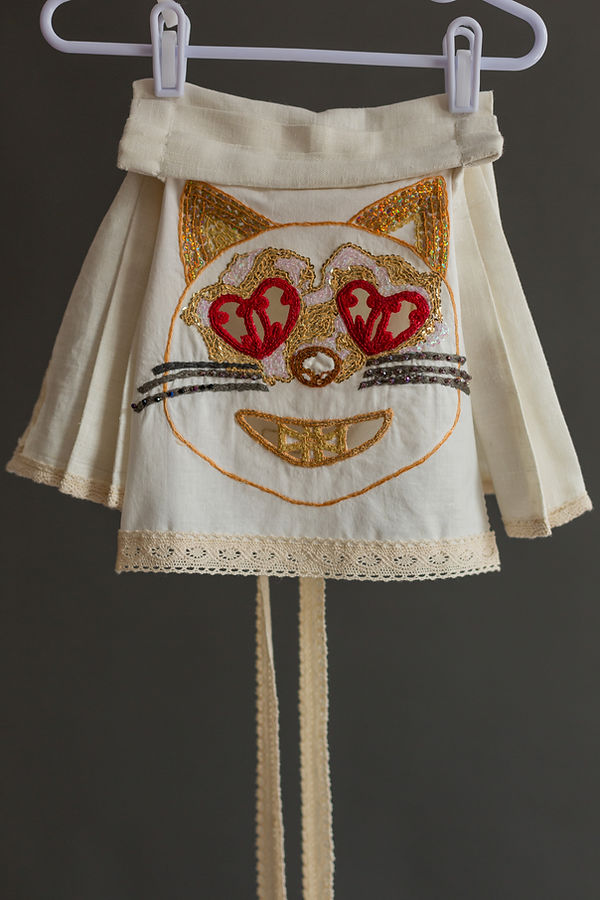.jpeg)
Olga Rudenko, <!--mother_&_child-->/ veil, 2019. Linen, embroidery, and sequins. 13 × 14 in.

Olga Rudenko, <!--in_Cookies_we_trust-->, 2021. Ink, gold leaf, and clay board. 72 × 48 × 2 in.

Olga Rudenko, <!--ignorance_is_freedom-->, 2021. Ink, gold leaf, and clay board. 72 × 48 × 2 in.
Q5. The child is a recurring figure in your practice. In <!--depository_of_the_soul-->, the mother-child relationship becomes a site where intimacy and algorithmic conditioning intersect. Why is this relationship so central to your exploration of care and control?
First of all, because I am a mother.
The experience of loving my daughter and having a physical and emotional bond with her—even though we are not biologically related—is the most profound and sacred relationship I know. It became impossible for me to think about humanity without thinking about the mother-child relationship.
It is also a relationship that has always occupied a central place in religion. Across cultures, mothers are associated with intuition, protection, sacrifice, compassion, and, at times, even prophecy. They nurture, but they also guide and protect. There is tenderness in motherhood, but there is also responsibility and, inevitably, a degree of control. All of those tensions interest me.
Above all, there is fear. I cannot imagine a greater human fear than losing a child.
What concerns me today is that this loss no longer has to come through tragedy. It can happen gradually, through alienation. Technology inserts itself into the relationship almost invisibly. It occupies our attention before we notice it. It begins by creating physical distance, then emotional distance, and eventually, I think, spiritual distance. We increasingly rely on algorithms to tell us what to watch, what to believe, how to feel, and even how to relate to one another. Decisions that once depended on intuition, experience, and imperfect human judgment are quietly delegated to data-driven systems.
I see this in my own life. Technology competes for my daughter's attention every day, and I know it competes for mine as well. It is designed to do so. It alters not only how we spend our time but also how we experience one another.
That is the fear that runs through these works. The mother-child relationship is, for me, the most intimate measure of our humanity. If technology can fundamentally reshape that bond, it inevitably reshapes what it means to be human. That is the question I keep returning to in my work.


Olga Rudenko, <!--depository_of_the_soul-->, 2025. Silicone dolls, ink, gold leaf, embroidery, and sequins. 38 × 25 × 30 in.
Q6. Embroidery and stitching require slowness, repetition, and physical attention. What becomes possible when these processes are used to depict systems built around speed and automation?
Thoughtfulness. Care. Full physical and emotional presence.
Embroidery and stitching are conceptual choices, but they are also deeply personal. Someone once asked me where I learned to embroider. I was surprised by the question because I had never thought of it as something I had learned. It always felt as natural as washing my face or brushing my teeth. I think it came from my grandmother—from simply watching her hands and, eventually, using my own.
Historically, making and decorating clothing is one of humanity's oldest artistic practices. Embroidery has long carried symbols of protection, belief, memory, and identity. What interests me is that the process itself embodies those qualities. Every stitch requires attention. It cannot be rushed. Every stitch records the movement of a human hand. It contains time, touch, and care.
Most of the symbols I use—binary code, emojis, snippets of programming language—were born in a digital environment. They exist on flat screens and move at unimaginable speed. By embroidering them, I bring them into physical space. They become objects rather than information. They acquire weight, texture, and the traces of a human hand.
That transformation is important to me. Through touch, I give digital symbols a physical existence, but I also remind myself that technology is made by human beings. Code is not a force of nature. Algorithms are not inevitable. They embody human choices, values, desires, and biases.
If technology creates problems, they are ultimately human problems. If we want to change them, the responsibility belongs to us, not to the machines.
Q7. In the <!--in_a_pickle--> series, the stitched figures are sealed inside glass jars like preserved medical specimens. What does containment allow you to express about the contemporary body?
I think of the human body as an essential part of our humanity. For me, the body is the depository of the soul.
One of the central questions in my work is whether altering the body also alters the soul. As we increasingly optimize ourselves—for longevity, beauty, health, or performance—are we also changing our understanding of what it means to be human? At what point does enhancement become transformation? And how would we recognize that moment?
The body has become the place where many of these questions converge. It brings us back from the virtual world to physical reality. We may construct digital identities, but we still inhabit physical bodies.
In the <!--in_a_pickle--> series, the stitched figures are preserved inside glass jars like medical or scientific specimens. I wanted them to exist somewhere between care and experimentation, between preservation and containment. The jars suggest that these bodies are precious, but they also imply observation, classification, and the possibility of intervention.
The series reflects on what happens when we begin adjusting our physical bodies to match the expectations of our digital lives—when the body itself becomes something to optimize, edit, and continuously update. I keep returning to the same question: Where does the soul go?
There is also a measure of dark humor in the title In a Pickle. It suggests being trapped in a difficult situation, but it also refers quite literally to preserving something in a jar. That ambiguity reflects how I feel about the future. As technologies such as DNA editing become increasingly accessible, we are entering a period of extraordinary possibility, but also profound uncertainty. I don't think we yet understand what kind of humanity we are preserving—or creating.


Left: Olga Rudenko, <!--in_a_pickle--> #1, 2024. Silicone doll, cotton, embroidery, sequins, ink, and glass jar. 16 × 6 × 7 in.
Middle: Olga Rudenko, <!--in_a_pickle--> #2, 2024. Silicone doll, cotton, embroidery, sequins, ink, and glass jar. 16 × 6 × 7 in.
Right: Olga Rudenko, <!--in_a_pickle--> #4, 2024. Silicone doll, cotton, embroidery, sequins, ink, and glass jar. 16 × 6 × 7 in.
Q8. In <!--strong_woman_tender_wounds-->, emojis make private suffering more visible while also concealing the woman behind them. What does this tension reveal about how pain is communicated?
As with most of my work, there are several layers to that question. My practice is ultimately more about questions than answers.
One reason I don't depict human faces is to draw attention to the gradual loss of privacy. We increasingly live in a world where our identities are collected, analyzed, and monetized by data-gathering algorithms. In my work, emojis often function as masks. They conceal the individual while also suggesting that privacy itself has become something we have to protect.
There is another layer. I use emojis extensively—embroidered into sculptures, repeated across backgrounds, or covering faces—to reflect on how digital communication reshapes our understanding of emotion. Emojis reduce complex emotional experiences to a small set of standardized facial expressions. But in physical life, emotions are never expressed through the face alone. They exist in touch, posture, gesture, movement, silence, proximity, and distance. They are often contradictory. We can feel grief and hope, fear and love, tenderness and anger at the same time.
In <!--strong_woman_tender_wounds-->, I am not using emojis to make suffering visible. I am doing almost the opposite. I am questioning whether suffering can ever be reduced to a crying face or a sad face. Human suffering contains love, sacrifice, resilience, dignity, and countless other emotions that resist simple categorization.
More broadly, the painting reflects my concern that technology encourages us to think of human experience as something that can be defined, measured, and quantified. We increasingly expect emotions to become clear, readable, and instantly communicable. But as long as they remain human, they resist that kind of certainty.
There is also the question of quantity versus quality. We communicate with hundreds of people through digital platforms and are expected to respond emotionally to all of them. That is almost impossible in human terms. Emojis make this enormous volume of communication manageable, but they also simplify our emotional vocabulary. They make communication more efficient while gradually reducing our capacity to perceive the complexity of one another.
Perhaps that is what concerns me most. In our pursuit of convenience, we may not be learning to understand each other better. We may be losing our ability to recognize the richness and contradictions that make human emotions profoundly human.

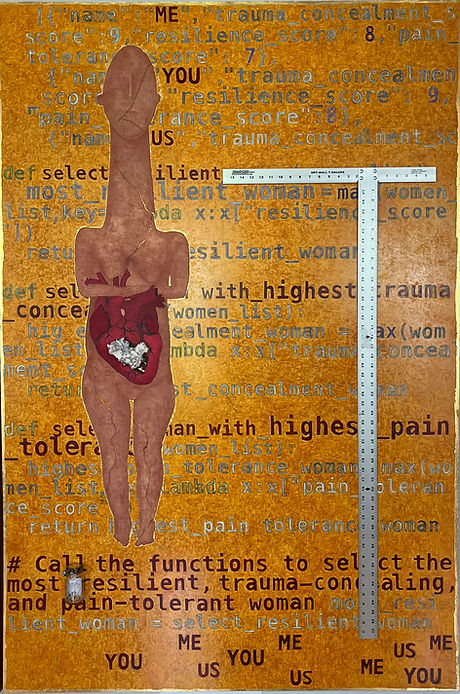
Left: Olga Rudenko, <!--strong_woman_tender_wounds-->, 2022. Ink, paper, gold leaf, clay board, and toy. 72 × 48 × 2 in.
Right: Olga Rudenko, <!--woman_with_big_heart-->, 2023. Ink, paper, gold leaf, aluminum, clay board, and glass jar. 72 × 48 × 2 in.
Q9. Many of your titles are formatted to resemble HTML comments. What does it mean to name an artwork through a form of language intended to remain hidden from the visible interface?
Yes, all of the AI_Augmented_Iconography titles are written using HTML comment syntax.
In programming, HTML comments are written for humans rather than for machines. They can contain explanations, reminders, or thoughts that remain invisible when the code is running. You can rewrite them endlessly without changing what appears on the screen. I found that idea fascinating.
It felt like a natural extension of my concept. In the digital world, almost everything can be edited, rewritten, optimized, or fictionalized while the visible interface appears unchanged. Using HTML comments as titles acknowledges that condition. The titles themselves become another layer of the work—present, but hidden.
There is also humor in that decision. My work has always contained a measure of farce, especially the earlier AI_Augmented_Iconography pieces. I enjoy taking conceptual ideas and making them almost embarrassingly literal. In <!--in_Cookies_we_trust-->, for example, there are actual cookies, crackers, and waffles in the painting. I find that kind of literal translation funny. I don't take my art too seriously, even when I am asking serious questions.
Perhaps there is one more reason I keep the titles hidden.
I would like to believe that the most valuable part of an artwork is not what is immediately visible. It is the part that stays with the viewer after they leave—the question that lingers, the shift in perception, the conversation that continues internally. In that sense, the HTML comment became a fitting metaphor. The most important part of the work may be the part that remains unseen.
Q10. In <!--the_empty_handed_gods-->, classical religious figures are overtaken by emojis and AI-generated language. What kinds of beliefs and expectations do you think contemporary society projects onto technology?
I think we project onto technology what humans have always projected onto powerful systems: hope, fear, trust, authority, and the desire for guidance.
Technology began as a tool, but as we gradually surrendered more of our privacy and entrusted it with more aspects of our lives, our relationship with it changed. We now ask algorithms what to read, where to go, whom to date, what to buy, and increasingly, what to think. It is almost inevitable that we begin to experience these systems as something more than tools.
That is one of the alterations I am interested in. I don't think this process can simply be stopped. The question is how conscious we remain of it.
At the same time, it is important to remember what artificial intelligence actually is. It does not possess human experience, consciousness, or emotions. It processes patterns in data.
<!--the_empty_handed_gods--> grew directly out of a conversation I had with ChatGPT in 2024. I asked how much insight it truly had into humanity and human feelings. Its answer was remarkably honest: its responses were generated from patterns in the data on which it had been trained. I found that answer more interesting than a claim to understand us.
Human beings naturally anthropomorphize the world around them. We attribute intentions and emotions to animals, objects, and natural forces. It is not surprising that we now do the same with artificial intelligence, especially because it speaks our language—and often speaks it in ways we want to hear.
The title <!--the_empty_handed_gods--> reflects that realization. We keep looking to technology for certainty, wisdom, and meaning, but perhaps what it ultimately offers is a reflection of ourselves. The gods are empty-handed because they have nothing of their own to give us. What we receive from them is, in many ways, our own humanity returned to us through data and algorithms.

Olga Rudenko, <!--the_empty_handed_gods--> #1, 2024. Paper, ink, and gold leaf. 68 × 38 in.

Olga Rudenko, <!--the_empty_handed_gods--> #2, 2024 (detail). Paper, ink, and gold leaf. Overall dimensions: 68 × 38 in.
Q11. Your work often asks how technology alters human life. What part of your own life do you try to keep deliberately “unaugmented”?
I try to remain grounded—both literally and metaphorically.
I still need physical labor in my life. I need to work with my hands, to spend time with materials, to feel connected to the physical world rather than only its digital reflection.
And I try to protect my ability to make mistakes.
Making mistakes is an essential part of my artistic process. They slow me down, force me to pay attention, and often lead me somewhere I had never intended to go. Imperfection is not something I try to eliminate. It is one of the qualities that make us human.
Perhaps that is the part of myself I want to keep unaugmented: the freedom to remain an imperfect human being.
Q12. Looking back on the evolution of your practice, what lessons would you share with emerging artists about sustaining an artistic life through personal, political, and technological change?
Embrace change, and don't be afraid to wander into the unknown.
Pay attention to your life. Observe carefully. Treasure your experiences, even the difficult ones. They become part of your work in ways you cannot predict.
Learning your craft and understanding your materials are essential. But over time, I have realized that making art is much more than mastering a technique. It is a deeply personal relationship with your materials—a relationship built on curiosity, affection, frustration, resistance, negotiation, and, occasionally, surrender. Every medium has its own character, and part of being an artist is learning to listen to it.
My greatest fear as an artist is not failure. My greatest fear is reaching a point where I know exactly what I am doing and can simply repeat it. That would mean the mystery is gone. The possibility of surprise disappears. The process becomes a series of tasks instead of a journey of discovery. I hope I never stop making mistakes.
And perhaps the most important lesson has very little to do with art. Work on becoming a good human being. Protect your own humanity, and recognize the humanity of others. I think that is the greatest responsibility of being human.