
Painting Memory and Belonging
Oluwaseun Elizabeth Adelaja’s work is distinguished by its emotional sensitivity and attentive observation of everyday life. Working across painting, photography, and drawing, she transforms quiet gestures, familiar objects, shifting light, and remembered places into reflections on identity, care, migration, and belonging. Her work reminds us that personal histories are preserved not only through major events, but also through ordinary moments, relationships, and the subtle visual details that remain with us over time.
From ArtVanguard Editorial Team
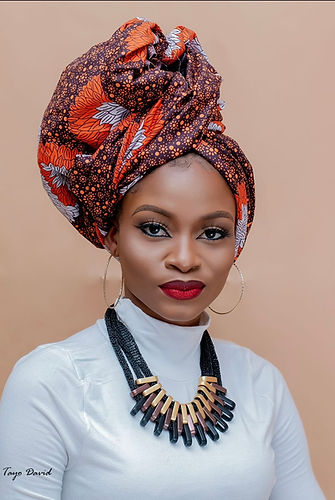
Portrait of Oluwaseun Elizabeth Adelaja
Artist Biography
Oluwaseun Elizabeth Adelaja (b. January 8, 1998) is a Nigerian-born visual artist working across painting and photography. She was raised in Ogun State, Nigeria, where her early interest in visual storytelling and creative expression began to shape her artistic identity.
She studied Creative Arts at Tai Solarin Federal University of Education, Ijagun, Ogun State, graduating in 2018 with a Bachelor of Arts in Education (B.A.Ed), Second Class Upper Division (CGPA 4.2). During her academic training, she developed strong technical and conceptual skills through studio practice and critical engagement, under the mentorship of Mr. Adekoya Samson (Samkay), Professor Abiodun Banjo, Professor Olatuji Idowu, Dr. Kafar, and Mr. Abiodun Abodunrin.
Oluwaseun’s practice is grounded in an intuitive and expressive approach, drawing inspiration from personal experiences, cultural memory, and human presence. Her ability to work fluidly across multiple mediums allows her to build a cohesive and evolving visual language.
Beyond her studio practice, she has contributed to arts education by teaching art in secondary schools and continues to give back to her community through painting workshops in the United Kingdom.
Based in Hull, UK, Oluwaseun continues to expand her artistic practice, blending her Nigerian heritage with contemporary influences to create meaningful and culturally resonant visual narratives.
Artist Statement
I am a contemporary visual artist working across photography and painting, with a practice grounded in visual storytelling and psychological presence. My work explores identity, inner life, and lived experience, particularly within Black and African contexts, using realism and expressionism as tools for emotional depth rather than surface likeness. Across mediums, I am drawn to moments of stillness, reflection, and quiet tension spaces where personal narratives intersect with collective memory.
My artistic development has been shaped by both formal and informal mentorship, sustained self-directed practice, and professional engagement through exhibitions, commissions, and community-based art initiatives. I have exhibited my work through curated platforms and produced commissioned portraits that require both technical precision and emotional sensitivity. These experiences have strengthened my ability to translate lived realities into visually compelling and culturally resonant works.
Photography and painting coexist in my practice as complementary modes of inquiry. While photography allows me to explore atmosphere, symbolism, and narrative framing, painting and drawing enable slower, more intimate engagements with the subject. Together, they form a cohesive body of work that prioritises emotional honesty, cultural specificity, and technical discipline.
My intention is to continue developing exhibition-led projects, collaborative initiatives, and educational engagements that contribute to the UK art sector while amplifying underrepresented narratives through thoughtful, rigorous visual practice. I am committed to long-term artistic development, professional integrity, and cultural contribution.
Interview with Oluwaseun Elizabeth Adelaja
Q1. You were born and raised in Lagos State, while your family roots and undergraduate education connect you to Ogun State. Looking back at your early life, what visual memories, places, people, colors, or everyday experiences first shaped your sensitivity to visual storytelling?
Growing up in Lagos exposed me to many visual experiences every day. The busy streets, markets, yellow buses, different kinds of people, and constant movement all made me pay attention to detail. At the same time, spending time in Ogun State gave me a different experience—one that was calmer and more connected to family and tradition. I became fascinated by people’s expressions, body language, and the emotions they carried, even when they said nothing. Looking back now, I realise that those everyday moments trained my eye to observe stories that often go unnoticed, and that has remained at the heart of my work.
Q2. You studied Creative Arts at Tai Solarin Federal University of Education and were trained under several mentors. How did your academic education influence your painting techniques, your way of seeing, and your broader understanding of art?
Studying Creative Arts gave me a solid technical foundation. I learnt drawing, composition, colour theory, and different painting techniques, but more importantly, I learnt how to think as an artist. My lecturers challenged me to look beyond creating beautiful images and to ask what a work was communicating. That shifted my perspective. Art became a way of asking questions, preserving memories, and expressing emotions. The guidance I received from my mentors continues to influence how I approach every new body of work.
Q3. Your works carry a quiet yet powerful psychological presence. How do you understand the place of “inner life” in your artistic practice?
For me, the inner life is where many of our most authentic experiences exist. People often hide what they are feeling, yet those emotions shape how they live and relate to others. My work explores those silent spaces: hope, loneliness, healing, resilience, and reflection. I am interested in creating works that encourage people to pause, look inward, and perhaps recognise something of themselves in the image.
Q4. Echoes of Home directly engages the idea of home. As a Nigerian-born artist now based in the UK, how has your understanding of “home” changed over time?
Living in the UK has changed my understanding of home. Home is no longer just a physical place for me. It has become something carried through memories, relationships, culture, and identity. There are moments when I miss familiar sounds, food, language, and community, but I have also learnt that home can grow wherever you build meaningful connections. Echoes of Home reflects that journey of holding on to where I come from while embracing who I am becoming.
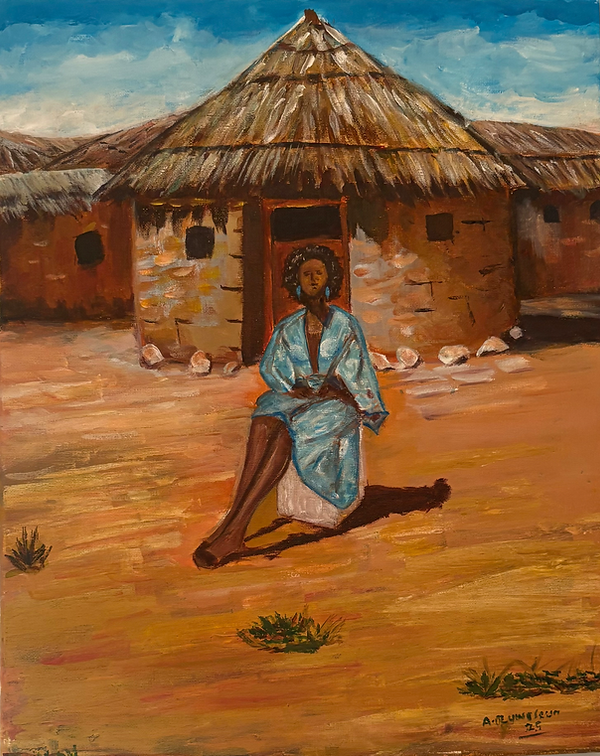
Oluwaseun Elizabeth Adelaja, Echoes of Home, 16 x 20 in., Acrylic on Canvas, 2024.
Q5. Color plays a powerful role in your paintings, from the deep reds of Never Alone to the luminous blues and greens of Distant Glow. How do you choose your color palettes and what emotional or cultural meanings do colors carry for you?
Colour is one of the first emotional decisions I make when starting a painting. I don’t usually choose colours simply because they look attractive; I choose them because they communicate a feeling. Warm colours often express strength, passion, or emotional intensity, while cooler colours create moments of peace, reflection, or hope. Sometimes, my colour choices are also influenced by memories of Nigerian life—fabrics, celebrations, and everyday environments. I want colour to become part of the story rather than simply decoration.
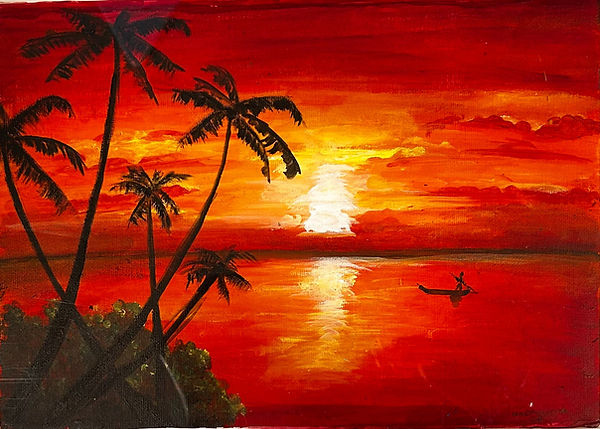
Oluwaseun Elizabeth Adelaja, Never Alone (from Quiet Horizons), 16 x 20 in., Acrylic on Canvas, 2024.
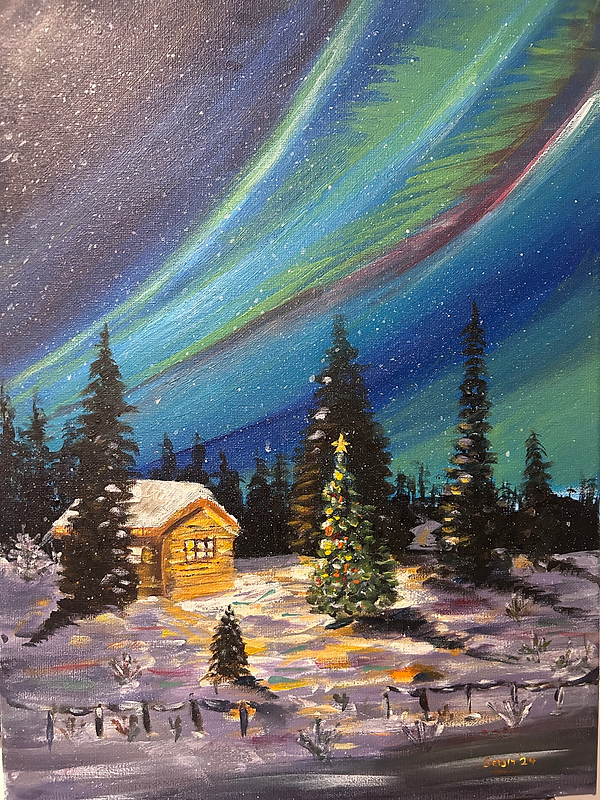
Oluwaseun Elizabeth Adelaja, Distant Glow (from Quiet Horizons), 16 x 20 in., Acrylic on Canvas, 2024.
Q6. You have taught art in secondary schools and continue to lead painting workshops in the United Kingdom. As both an artist and an educator, how does teaching influence your own studio practice?
Teaching constantly reminds me that creativity is a lifelong process. Every time I explain a concept to students, I also challenge myself to think differently about my own practice. I enjoy seeing people discover confidence in their creativity and that energy often inspires me in the studio. Teaching has also helped me become more patient, more experimental and more open to learning from others.
Q7. After the Rain and The Transition are photographic works, but they do not feel like simple records of reality. They strongly emphasize atmosphere, light, and psychological states. What draws you to photography, and how does it differ from painting as a way of exploring mood, memory, and narrative?
Photography allows me to respond to moments as they happen. I enjoy working with natural light, atmosphere, and composition to capture emotions that may exist only for a brief moment. Painting is different because it gives me more freedom to reinterpret memories, simplify forms, and build emotional layers over time. While both mediums explore similar themes, photography often begins with observation, whereas painting usually begins with reflection.

Oluwaseun Elizabeth Adelaja, After the Rain, 16 x 20 in., Photography.
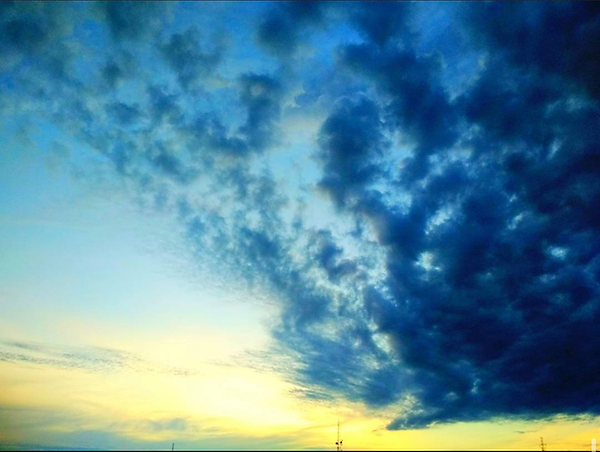
Oluwaseun Elizabeth Adelaja, The Transition, 16 x 20 in., Photography.
Q8. You work across painting, photography, and drawing. Do different mediums allow you to access different parts of your imagination or memory?
Definitely. Drawing helps me think through ideas quickly. Photography captures experiences as they unfold, while painting allows me to slow down, process memories and express emotions more deeply. Each medium has its own language, and together they help me tell stories in different ways.
Q9. In Caregiver, the figure is surrounded by vivid floral colors and appears both strong and inward-looking. What does care mean in this work? Is it connected to family, labor, healing, memory, or something more personal?
Caregiver reflects the quiet strength of people who continue giving, even when their own needs are not always visible. It speaks to compassion, resilience, and emotional labour. While the work is inspired by personal observations, I also hope it resonates more broadly with parents, healthcare workers, family members, and anyone whose daily life revolves around caring for others. The flowers represent growth, hope, and the beauty that can exist even within sacrifice, while the elongated neck symbolises the weight that caregivers carry within.

Oluwaseun Elizabeth Adelaja, Caregiver, 42 x 59.4 cm, Acrylic on Canvas, 2026
Q10. Harvest presents fruits and objects in a still-life composition. How do food, land, abundance, or everyday domestic objects connect to your broader interest in culture and lived experience?
I see everyday objects as part of our cultural memory. Food, fruits and household items carry stories about family, celebration, work and tradition. Harvest is about more than abundance; it is about gratitude, identity and the ordinary things that quietly shape our lives. I enjoy finding meaning in familiar objects that people sometimes overlook.
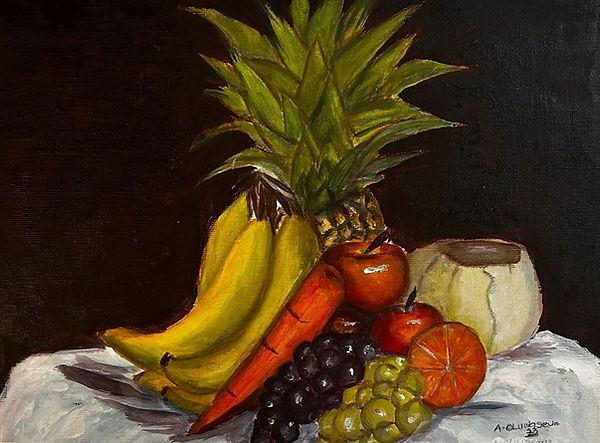
Oluwaseun Elizabeth Adelaja, Harvest, 29.7 x 42 cm, Guoche on Card.
Q11. Harvest presents fruits and objects in a still-life composition. How do food, land, abundance, or everyday domestic objects connect to your broader interest in culture and lived experience?
I would like to continue exploring identity, migration, belonging, and emotional well-being, especially within African and diaspora communities. I am also interested in combining painting, photography, and digital storytelling in more immersive ways. Collaboration is important to me, and I hope to work more closely with community organisations, schools, and cultural institutions on projects that encourage dialogue and bring people together through art.
Q12. What advice would you give to young artists or art students who are still developing their voice, especially those trying to balance technical training, personal experience, and cultural identity in their work?
My advice is to be patient with yourself. Learn technical skills because they give you confidence, but don’t let technique become more important than your own voice. Pay attention to your experiences, your culture, and the stories that matter to you, because that is where your uniqueness comes from. Keep creating, keep learning, and don’t be afraid to grow. Your artistic voice develops over time through consistency, curiosity, and honesty.