
An Alphabet of Footprints: Memory, Movement, and Belonging
Zoë Elena Moldenhauer’s practice transforms language into a living, material, and spatial system. Beginning with an invented alphabet shaped by questions of adoption, ancestry, and cultural memory, her work moves across painting, collage, printmaking, soft sculpture, projection, bookmaking, and found objects. Rather than treating absence or illegibility as lack, Moldenhauer turns them into sites of play, mapping, and possibility. Through fabric, bread tags, buttons, projections, and hand-built signs, her visual language creates a world where identity is not simply recovered, but continually traced, translated, and remade.
From ArtVanguard Editorial Team

Portrait of Zoë Elena Moldenhauer
Artist Biography
Zoë Elena Moldenhauer is a Guatemalan-born, New York City-based artist. She received a BFA from the Maryland Institute College of Art in 2019 and an MA from New York University in 2022. She is the founder of The Aerogramme Center for Arts and Culture, an online platform founded in March 2020 that provides opportunities for artists and writers. Zoë resides in New York, where she has a studio at Brooklyn Art Cluster and is an Amos Eno Gallery community and board member.
Artist Website: https://zoemoldenhauer.com
Instagram: @zoe_moldenhauer
Artist Statement
In 2017, I invented an alphabet. This alphabet draws from my transracial adoption, absent heritage, and Western upbringing. As a Guatemalan adoptee, I have always been curious about my genealogy, and this alphabet is a tool to create identity and research my ancestry.
In graduate school, I took a class in the Nahuatl language, an Aztec/Mexica language. I fell in love with Nahuatl and continue to pursue the language as an act of colonial resistance. In my own small way, I have found belonging in a class with others who were relearning their own cultures and histories. In 2024, I visited the Nazca geoglyphs in Peru, and in 2025, I visited the cave paintings at Serra da Capivara in Brazil, where I incorporated the sites’ pictorial languages, as well as Nahuatl, into my alphabet.
My alphabet is my medium. I use a range of materials suited to each project, including video projection, installation, printmaking, and collage. I primarily work from linoleum blocks of my alphabet, where I lay out and pull prints onto fabric or paper. I sew yarn, buttons, zippers, beads, and other found materials onto the surface to create abstract maps. Using markers, wax crayons, and pencils, I create fictional constellations and mathematical notations. My large-scale work incorporates sound and manipulated images to create immersive environments. The Nahuatl and pictorial languages from Brazil and Peru, as well as my own alphabet, are secret, but by manually transcribing them, I study the composition and structures of these languages to understand and make visual interpretations.
Interview with Zoë Elena Moldenhauer
Q1. You received your BFA from the Maryland Institute College of Art in 2019 and later earned your MA from New York University in 2022. How did these two educational environments shape the development of your artistic language, especially your interest in identity, invented language, and cultural memory?
In undergrad, I took my first class on Latin American Art. I was adopted from Guatemala, and my undergraduate years were the first time I sought out Latino/Latin American connections through which to place myself. During my freshman year, I joined a student identity-based organization and took one of two classes offered on Latin American Art; the other, taught by the same professor, was on Latin American Literature. This class exposed me to artists like Xul Solar and Joaquín Torres-García, who combined Mesoamerican imagery with their contemporary visual expression. I resonated with these artists’ ideas and began to develop my own fictional alphabet inspired by Mayan and Aztec writing systems to bridge my ancestry with my artistic practice.
By the time I pursued a Master’s at NYU, I was invested in developing foundational knowledge in Latin American and Caribbean studies and entering the field professionally. The framework was a challenge for me, but I developed an interest in borderland studies, Aztec map-making, extractivism, and racism. This academic framework began appearing in my art through themes of place, placemaking, and footsteps as I worked between my academic studies at NYU and my studio practice. My work between 2020 and 2022 evolved from painting to monoprint and collage as a byproduct of the pandemic closures. I was working from my bedroom, then found studio space in Gowanus, Brooklyn, where I continued to work. My financial resources were limited at the time, but I had endless scrap materials, from fabrics to yarn and buttons, that I hoarded and used in my work.
Q2. In 2017, you invented an alphabet that has since become central to your work. Can you speak about the moment when this alphabet first emerged, and how it changed your understanding of what an artwork could do?
Being adopted is a singular experience, but I grew up in a multilingual home where my parents spoke Spanish, French, German, and Hebrew. I have a memory of wanting to teach myself Old English after getting a copy of Beowulf in high school that had the dual translation of English and Old English side by side. I never learned Old English, and Spanish is a language I had to learn. There is bitterness and shame in having to learn a language your identity is associated with, and while I had no control over how my brain processed information, I transformed my frustration, anger, and shame into curiosity and playfulness with my alphabet. I am also dyslexic, and I found that the inability to read or understand something that appears as instruction or information became the niche I wanted to continue to pull apart. Visual art has been the tool I use to process and communicate, which easily became the platform for my invented alphabet.
Q3. Your alphabet incorporates influences from Nahuatl, the Nazca geoglyphs in Peru, and the cave paintings at Serra da Capivara in Brazil. How do you approach these historical and cultural visual languages as living fields of study rather than simply as visual sources?
NYU offered Nahuatl courses through Lehman College. Pure curiosity and a need to fulfill a language requirement led me to take the class. I fell in love with the language instantly and was moved to be in a room with people who were learning about their own history and culture through Nahuatl, which felt like an act of colonial resistance. I took two semesters of Nahuatl and began incorporating the language into my art, either by naming my artwork or by imbuing words into pieces. Nahuatl, oddly enough, was easier for me to learn than Spanish, although both were required for the class. I felt empowered, seen, and happy, and I worked to capture that feeling in my art.
In 2024, I traveled to Peru and had the opportunity to visit the Nazca geoglyphs—more than 800 line drawings in the earth that are believed to be religious or part of a calendar system, though their function remains unknown. I took aerial photos and translated 26 of the geoglyphs into linocuts. I later scanned the linocuts, along with my own alphabet, and turned them into a font where each linocut corresponded to a letter of the alphabet. Working from a font opened a new avenue for my work, where I began to work bigger and blend digital design with fine art.
The next year, I did a residency in Brazil that included a weeklong excursion to Serra da Capivara National Park, which contains a wealth of cave paintings. Again, I documented the cave paintings and translated ten that resonated with me into linocuts, later adding these new images into my font. It was during this residency, and through wonderful conversations, that I was asked about my alphabet and adoption. I was asked if I was interested in returning to Guatemala and seeking out my biological family. While I am not interested in that now, my alphabet became a tool for tracing my ancestors and connecting culturally with my genetic makeup. Through DNA testing, I learned that I was Guatemalan, but also broadly Bolivian, Mexican, and Portuguese, which allows me to appreciate a multitude of cultures and build connections through my alphabet.

Zoë Elena Moldenhauer, Tlapixqui (Katatl), 2026, soft sculpture, 92 × 45 in.

Zoë Elena Moldenhauer, Tlapixqui (Miston), 2025, soft sculpture, 84 × 50 in.
Q4. In your Tlapixqui series, what drew you to large-scale soft sculpture as a way to extend your alphabet into physical and spatial form? What kinds of presence, care, or witnessing do you imagine them holding within your broader practice?
I got my first solo opportunity at Art Cake in March of 2026. Through previous feedback I had received, I was encouraged to inhabit my alphabet. I selected six pictorial images from my alphabet and created large, nine-foot soft sculptures using tarp and newsprint paper. I then wrapped each sculpture in fabric, which was the most fun. I originally leaned toward solid color, but fell in love with an electric blue cheetah print, a speckled brown fabric, a green wavy pattern, and a brown-pink print. As I wrapped the sculptures in fabric, names started to come to me in Nahuatl: one each for frog, fly, cow, rooster, cat, and dog. They became guardians, “tlapixqui” in Nahuatl, that accompanied a person on an interpersonal or physical journey. My solo exhibition mainly drew from my trip to Serra da Capivara National Park, where I photographed the landscape and selected photos that I digitally manipulated into moving wall projections.
Serra da Capivara, I learned, is claimed to have evidence of early human settlement predating the crossing of the Bering Strait. Occupying a space where people documented their journeys from thousands of years ago was moving, and I reflected on the fears I felt returning to the United States, terrified I would be profiled by TSA. Movement is a part of everyone’s lives, and I wanted to celebrate the beauty of migration/movement while also noting the pain of our current political climate. The culmination of my fear and my visit to this national park led me to title my exhibit pegadas, which means “footprints” in Portuguese. I was amazed by the response and by how people stayed for long periods to watch the videos and recount memories or facts about historical sites that made them think about their past and present.
Q5. What roles do uncertainty, translation, and revision play in your studio process?
It is never a good feeling not knowing when the next project will hit. Sometimes it is days or months before you make something. I have learned that sitting in discomfort is okay. I make sure to show up to my studio, inhabit my creative space, and give myself the flexibility to try to make something. If nothing comes of it, then I try again the next day.
Because I have my alphabet, I fiddle around with scrap fabrics or play with my font in Adobe. The Nazca geoglyphs and cave paintings from Serra da Capivara don’t have direct translations, which allows me to interpret these figures in any way. My rules change constantly, sometimes associating them with feeling rather than a message. Other times, color dictates a work, and my alphabet is a supporting element. Collage and printmaking are excellent formats because they force thoughtful composition that can be disassembled and reassembled in new ways. I love when the final artwork is messy and chaotic but playful through the use of plastic bread tags or buttons. These small found objects create a sense of immediate connection, while my alphabet is secret and my own. I love that duality.

Zoë Elena Moldenhauer, Tlapixqui (Chichi), 2026, tissue paper, tarp, and fabric, 87 × 56 in.

Zoë Elena Moldenhauer, Tlapixqui (Kwapelech), 2026, soft sculpture, 92 × 33 in.
Q6. Your recent works such as Unnecessary Delay, Hither/Dither, and Barrilete incorporate materials including plastic bread tags, beads, yarn, wax crayon, oil stick, monoprint, fabric, and found objects. What draws you to these everyday and tactile materials, and how do they shape the emotional and narrative dimensions of the work?
I took an art and writing workshop where my assignment was to create a lexicon with themes and interests, as well as materials and processes. I defined my terms according to how I use or discuss them in relation to my practice, or to how they feature visually in my work. For example: buttons = destination, place, markers; and language = community among people. This lexicon became a second layer to my alphabet that grows when I experiment with a new medium or add new themes. These terms also become an entry point for viewers who can’t read my alphabet but can resonate with the found objects that appear in my work.
The lexicon doesn’t dictate how I approach a work of art, but serves as a map or manual for how I am thinking and how my alphabet functions in my work. Likewise, many of these materials are generally found in my kitchen or around my house. Bread tags are widely available, and I repurpose old clothing and extract zippers and buttons. I like that found materials are whimsical and playful, but can also be seen through their intended use, which creates another layer of humor.


.jpg)
Left: Zoë Elena Moldenhauer, Hither/Dither, 2026, plastic bread tags, beads, yarn, wax crayon, oil stick, monoprint on paper, and mixed fabric, 31 × 37 in.
Middle: Zoë Elena Moldenhauer, Unnecessary Delay, 2026, plastic bread tags, beads, yarn, wax crayon, oil stick, monoprint on paper, and mixed fabric, 28.5 × 36 in.
Right: Zoë Elena Moldenhauer, Barrilete, 2025, fabric, beads, wax crayon, paint marker, monoprint, bread tags, plastic, and found objects on canvas, 21 × 18 in.
Q7. In Creative Vernaculars, you work with a jacket as both surface and object. What interested you in clothing as a site for language, identity, or performance?
Bookmaking is a recent field I’ve been exploring in my practice. I wanted to incorporate my lexicon into a physical object, but felt that a standard book format wasn’t enough. I had a red worker’s jacket I never wore and began sewing my lexicon onto the back. I repurposed printed fabric of my alphabet to line the inside of the jacket and embellished the front with yarn, beads, zippers, and scrap monoprints. I liked the idea of inhabiting my alphabet, and that a transformation of some kind would occur when I put the jacket on. I wanted my jacket to be an archive that I could wear and point to when referencing my lexicon.
Q8. Your practice engages with genealogy, ancestry, and cultural absence, but it does not seem to treat absence as emptiness. How do you think about absence as a generative space within your work?
This is a really good question.
With time, I’ve learned that the absence I hold regarding my adoption isn’t so much about grief and pain anymore, but about possibilities. My work is largely made up of variations of mapmaking and placemaking that can be interpreted as trying to create my own paths, find my way back to something, or move toward something. I think absence serves as a space to be created. Maybe what I am doing is creating sections of a larger map that has yet to be filled. I’ll only know with time, but I’m not scared of the emptiness—I’m more excited to see what it becomes.


Zoë Elena Moldenhauer, Creative Vernaculars (front, inside, and back), 2025, yarn, beads, silk, canvas, monoprint, and wax crayon on jacket, 16.5 × 29.5 in. each.
Q9. You recently presented your solo exhibition pegadas at Art Cake in Brooklyn, New York. Can you walk us through the immersive spatial setting of the exhibition, and how the show allowed your alphabet, materials, and visual language to unfold within a larger environment?
I was given the opportunity to show at Art Cake and had the daunting task of working with a space that was 33 by 18 feet, with 17-foot ceilings. I had the idea of working with video projections and making large-scale soft sculptures. For eight months, I worked on my sculptures and projection mapping, but it wasn’t until installation that I saw everything come together. The videos were the first to go up, and on the second day, we placed the sculptures—some of which hung on the wall and some of which were suspended from the ceiling. Working between the two media, and with limited installation time, it was a happy surprise to see how the videos interacted with the fabric of the sculptures and how the sculptures’ shadows created interesting shapes.
Seeing parts of my alphabet enlarged felt surreal and otherworldly. There was a playful and inviting feeling that was balanced with the projections of moving images, which provided a sense of calm. This was also the first time I externalized world-building in a narrative sense. I recall a conversation with someone who felt like the installation was like a pop-up book, where you can delve into the many layers, see the care, and admire the technical aspects that went into creating this space.

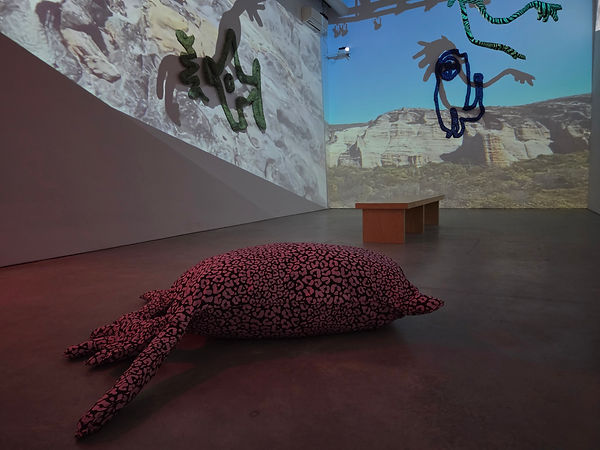
Zoë Elena Moldenhauer, installation view of pegadas at Art Cake, Brooklyn, NY, March 7–28, 2026.
Q10. In Relational Gaming, you present a set of 22 cards. What drew you to the format of a game, deck, or modular system, and how does that structure change the viewer’s relationship to your language?
Relational Gaming began as an early attempt to create a tarot deck. The 22 cards are meant to be the major arcana, but felt too abstract to work successfully in that form. I was inspired to make my own deck by the generations of artists before me who made their own. It felt like a rite of passage and became a physical object that I carry with me.
Games are about systems and communication, and I would love to interact with someone as they play with a deck of cards from my alphabet.

Zoë Elena Moldenhauer, Relational Gaming, 2025, collage, linocut, and wax crayon on canvas, 22 cards, 3.5 × 4.5 in. each.
Q11. Your background includes both artistic and curatorial work. You are also the founder of The Aerogramme Center for Arts and Culture, an online platform supporting artists and writers. How do your roles as artist, curator, organizer, and cultural worker inform one another?
I found a love for curating in undergrad. Baltimore fostered grassroots organizing and centered community practices. I was drawn to that, especially when organizing exhibits with the Hispanic/Latino student body at the Maryland Institute College of Art. I found joy in bringing people together and, as a Virgo, found fulfillment in the little details.
It was after graduating from MICA that I felt a sense of loss of community. I was on my own, without access to studio space and without the structure and security of the academic environment. I wanted to address that loss and create a book club for artists. The idea of The Aerogramme Center changed for a year, but became permanent when the pandemic closures went into effect and I started to organize online exhibitions that evolved into a quarterly magazine, artist interviews, and a podcast. I loved being able to connect people globally through The Aerogramme Center and seeing how artists and writers were transforming limitation into potential.
Over the years, I’ve continued to organize pop-up exhibits with artists whom I’ve met at residencies and formed great friendships with. New York City is truly a city of infinite possibilities and of communities where anyone can find their place. Being an artist can also be isolating. I work hard to maintain my studio practice and seek out residencies. I fear that feeling of being stuck, passive, and without support. I have found immense growth and change in my work through residencies. I thrive in community spaces where I can learn from other artists and develop professionally. Residencies are also a way to hold myself accountable, and I am fortunate enough to be able to pursue and support my practice in this way.
Q12. Looking ahead, are there particular questions, materials, spaces, or forms of public encounter that you hope to explore more deeply in the next stage of your practice?
I want to continue to develop video projection and installation. I want to continue to make books and find new materials to play with. There is no one thing I’m looking to accomplish, but I am ready for whatever comes next.